FORESTS WITHOUT NAMES
Brand
HYUNDAI
Entrant Agency
BBDO NEW YORK
Category
Design
Award
Bronze
Festival & Year
Cannes Lions (2026)
Case Study Details
There is a forest beneath the sea. 🌿🌊
Unlike forests on land, these sea forests remain unnamed and unmapped, despite being a vital ecosystem that supports marine life and helps protect our planet.
Now, we’re inviting the world to change that – to give them a name, an identity, and a place on the map. 🐟
Vote now to help name a sea forest in Australia at our website.
▶ ForestsWithoutNames (https://www.forestswithoutnames.com/)
▶ More details about Hyundai’s sea forest story (https://www.hyundai.com/worldwide/en/brand-journal/forests-without-names/article)
#Hyundai #ForestsWithoutNames #OceanConservation #EarthMonth
Presentation Board
/FORESTS WITH@EY¥F NAMES
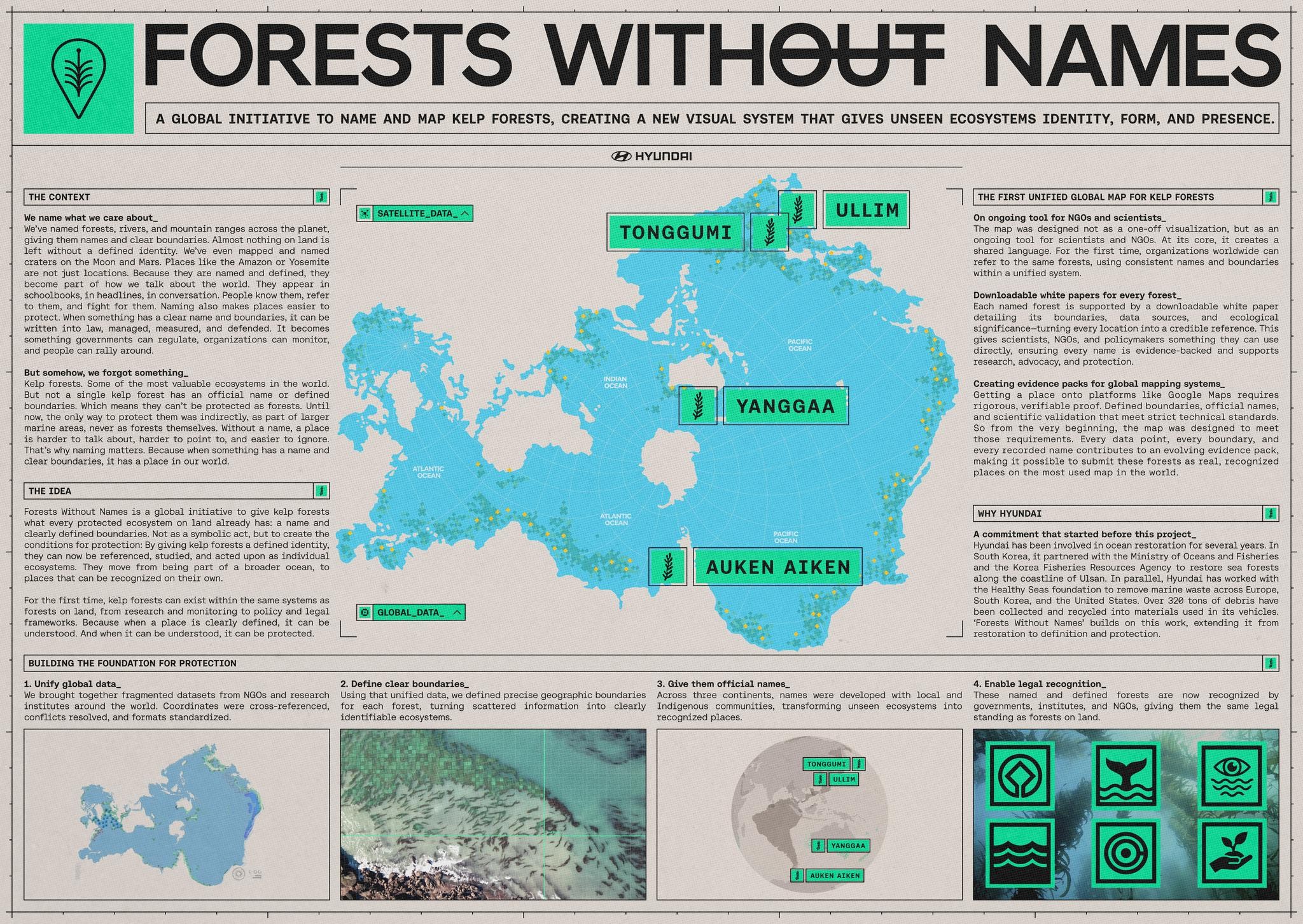
A GLOBAL INITIATIVE TO NAME AND MAP KELP FORESTS, CREATING A NEW VISUAL SYSTEM THAT GIVES UNSEEN ECOSYSTEMS IDENTITY, FORM, AND PRESENCE.
@ xHYunoAl
THE CONTEXT
We name what we care about_
We've named forests, rivers, and mountain ranges across the planet,
giving them names and clear boundaries. Almost nothing on land is
left without a defined identity. We've even mapped and named
craters on the Moon and Mars. Places like the Amazon or Yosemite
are not just locations. Because they are named and defined, they
become part of how we talk about the world. They appear in
schoolbooks, in headlines, in conversation. People know them, refer
to them, and fight for them. Naming also makes places easier to
protect. When something has a clear name and boundaries, it can be
written into law, managed, measured, and defended. It becomes
something governments can regulate, organizations can monitor,
and people can rally around.
But somehow, we forgot something_
Kelp forests. Some of the most valuable ecosystems in the world.
But not a single kelp forest has an official name or defined
boundaries. Which means they can’t be protected as forests. Until
now, the only way to protect them was indirectly, as part of larger
marine areas, never as forests themselves. Without a name, a place
is harder to talk about, harder to point to, and easier to ignore.
That’s why naming matters. Because when something has a name and
clear boundaries, it has a place in our world.
THE IDEA a
Forests Without Names is a global initiative to give kelp forests
what every protected ecosystem on land already has: a name and
clearly defined boundaries. Not as a symbolic act, but to create the
conditions for protection: By giving kelp forests a defined identity,
they can now be referenced, studied, and acted upon as individual
ecosystems. They move from being part of a broader ocean, to
places that can be recognized on their own.
For the first time, kelp forests can exist within the same systems as
forests on land, from research and monitoring to policy and legal
frameworks. Because when a place is clearly defined, it can be
understood. And when it can be understood, it can be protected.
SATELLITE_DATA_~
(| GLOBAL_DATA__~
LE
TONGGUMI || ¥ | —
YANGGAA
AUKEN AIKEN | —
2%
THE FIRST UNIFIED GLOBAL MAP FOR KELP FORESTS Zz
On ongoing tool for NGOs and scientists_
The map was designed not as a one-off visualization, but as an
ongoing tool for scientists and NGOs. At its core, it creates a
shared language. For the first time, organizations worldwide can
refer to the same forests, using consistent names and boundaries
within a unified system.
Downloadable white papers for every forest_
Each named forest is supported by a downloadable white paper
detailing its boundaries, data sources, and ecological
significance—turning every location into a credible reference. This
gives scientists, NGOs, and policymakers something they can use
directly, ensuring every name is evidence-backed and supports
research, advocacy, and protection.
Creating evidence packs for global mapping systems_
Getting a place onto platforms like Google Maps requires
rigorous, verifiable proof. Defined boundaries, official names,
and scientific validation that meet strict technical standards.
So from the very beginning, the map was designed to meet
those requirements. Every data point, every boundary, and
every recorded name contributes to an evolving evidence pack,
making it possible to submit these forests as real, recognized
places on the most used map in the world.
WHY HYUNDAI oY
A commitment that started before this project_
Hyundai has been involved in ocean restoration for several years. In
South Korea, it partnered with the Ministry of Oceans and Fisheries
and the Korea Fisheries Resources Agency to restore sea forests
along the coastline of Ulsan. In parallel, Hyundai has worked with
the Healthy Seas foundation to remove marine waste across Europe,
South Korea, and the United States. Over 320 tons of debris have
been collected and recycled into materials used in its vehicles.
‘Forests Without Names’ builds on this work, extending it from
restoration to definition and protection,
BUILDING THE FOUNDATION FOR PROTECTION
4. Unify global data_
We brought together fragmented datasets from NGOs and research
institutes around the world. Coordinates were cross-referenced,
conflicts resolved, and formats standardized.
2. Define clear boundaries_
Using that unified data, we defined precise geographic boundaries
for each forest, turning scattered information into clearly
identifiable ecosystems.
3. Give them official names_
‘Across three continents, names were developed with local and
Indigenous communities, transforming unseen ecosystems into
recognized places.
4, Enable legal recognition_
These named and defined forests are now recognized by
governments, institutes, and NGOs, giving them the same legal
standing as forests on land.
Pl [Naneene
J )[AUKEN ATKEN