T-REX LEATHER
Brand
LAB-GROWN LEATHER
Entrant Agency
VML
Category
Creative Data
Festival & Year
Cannes Lions (2026)
Case Study Details
Luxury fashion has always been built on heritage, craftsmanship and rare materials — but the future of luxury requires rethinking where those materials come from. While brands explore alternatives to animal leather, many struggle to create materials that feel truly premium and emotionally desirable. The opportunity was to move beyond imitation and create something completely new.
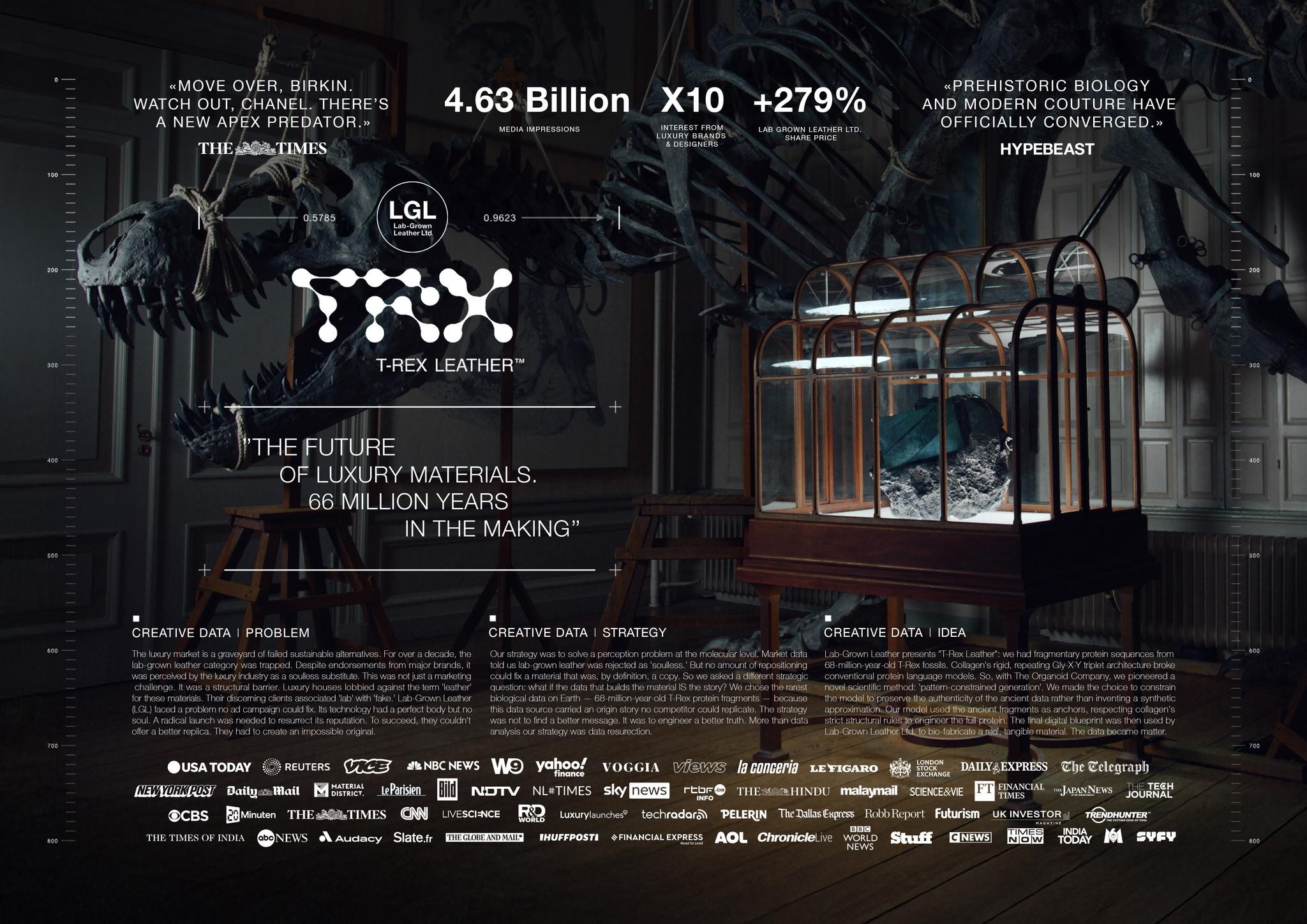
VML, The Organoid Company and Lab-Grown Leather Ltd. created T-Rex Leather™, the world’s first leather material inspired by a prehistoric species. By reconstructing fossilised T.rex collagen sequences through advanced biotechnology, the team created a futuristic luxury material that connects 66 million years of evolution with the future of sustainable design.
The material was transformed into a one-of-a-kind handbag by avant-garde techwear label Enfin Levé. Unveiled at Art Zoo Museum in Amsterdam beside a life-sized T.rex structure, the piece created a powerful contrast between prehistoric biology and future fashion. The project demonstrated the potential of lab-grown leather as a durable, traceable and animal-free alternative for luxury, fashion and beyond.
The launch generated global attention by turning a complex scientific innovation into a cultural conversation around the future of materials and sustainable luxury. The T-Rex Leather™ handbag became a unique collector’s piece, exhibited publicly before auction, while the project positioned VML, The Organoid Company and Lab-Grown Leather Ltd. at the intersection of biotechnology, creativity and future-facing design.
CREDITS
Brands & Innovation Partners: The Organoid Company, Lab-Grown Leather Ltd.
Creative Agency: VML Paris.
Global Chief Creative Officer, Innovation & CCO EMEA: Bas Korsten.
Design Partner: Enfin Levé.
Founder & Lead Designer: Michal Hadas.
Scientific & Technology Partners
Professor Che Connon, Lab-Grown Leather Ltd.
Thomas Mitchell, CEO, The Organoid Company.
Presentation Board
100
300
400
s00
600
700
«MOVE OVER, BIRKIN.
WATCH OUT, CHANEL. THERE’S
Lab-Grown
Leather Ltd
T-REX LEATHER™
THE FUTURE
- OF LUXURY MATERIALS.
66 MILLION YEARS
IN THE MAKING”
.
CREATIVE DATA | PROBLEM
The luxury market is a graveyard of failed sustainable alternatives. For over a decade, the
lab-grown leather category was trapped. Despite endorsements from major brands, it
was perceived by the knury industry as a soulless substitute. This was not just a marketing
challenge. It was a structural barrier. Luxury houses lobbied against the term ‘leather’
for these materials. Their disceming clients associated ‘lab’ with 'fake.' Lab:Grown Leather
(LGL) faced a problem no ad campaign could fx. Its technology had a perfect body but no
soul. A radical launch was needed to resurrect its reputation. To succeed, they couldn't
offer a better replica. They had to create an impossible original
4.63 Billion X10 +279%
INTEREST FROM.
LUXURY BRANDS
& DESIGNERS.
MEDIA IMPRESSIONS,
+
.
CREATIVE DATA | STRATEGY
‘Our strategy was to solve a perception problem at the molecular level: Market data
told us lab-grown leather was rejected as ‘soulless. But no amount of repositioning
could fix a material that was, by definition, a copy. So we asked @ different strategic
question: what if the data that builds the material IS the stony? We chose the rarest
biological data on Earth — 68-milion-year-old T-Rex protein fragments — because
this data source carried an origin story no competitor could replicate. The strategy
was not to find a better message. It was to engineer a better truth. More than data
analysis our strategy was data resurection.
«PREHISTORIC BIOLOGY
AND MODERN COUTURE HAVE
OFFICIALLY CONVERGED.»
LAB GROWN LEATHER LTD.
SHARE PRICE
HYPEBEAST
.
CREATIVE DATA | IDEA
Lab-Grown Leather presents “T-Rex Leather’: we had fragmentary protein sequences from
68-millon- year-old T-Rex fossils. Collagen's rigid, repeating Gly-XY triplet architecture broke:
conventional protein language models. So, with The Organoid Company, we pioneered a
Aovel/scientiic method: ‘pattern-constrained generation’. We made the choice to constrain
the model to preserve the authenticity of the ancient data rather than inventing a synthetic
approximation. Our model usedithe ancient fragments as anchors, respecting collagen’s
strict structural rules torerigineer the Tull protein. The final-digital blueprint was then used by
Lab-Grown, Leather Mato bio-fabricate ‘a.réal, tangible material. The data became matter.
Md Li Mt Leetert alin eran nan I |
@usATopay {-:reuters (CCS swNBCNEWS WE) yahoo! vocciA Ja conceria ‘LEFIGARO ee ee DAILYSEXPRESS @he Selegraph
AERELCOT DaitycamMait RA dsc _leParisien_ i} NOTV NLeTiMEs sky GEM cto6© THEssanmNpu malaymail scencesvie Bax mJARANNEWS — JQURNA
@cBS EBiminuten THEs@@&:TIMES GNN Livesci-Nce RO Luxurylaunches® techradars) ‘PELERIN TheDallasExpress RobbReport Futurism UK INVESTOR TRENDHUNTER-
Bos
‘THE TIMES OF INDIA Q)NEWS @Audacy Slater THUFFPOSTI SFINANCIALEXPRESS AAQL Chroniclel ive woatp Stuté news MS Woh i svev
Fr
300
400
500
600
700
200